


Active travel
Last year hundreds of school students enjoyed trips to the Broads by train to highlight rail as one of the easiest and most environmentally friendly ways to visit this protected landscape, with free travel provided by Greater Anglia, working with the Bittern and Wherry Lines Community Rail Partnerships.
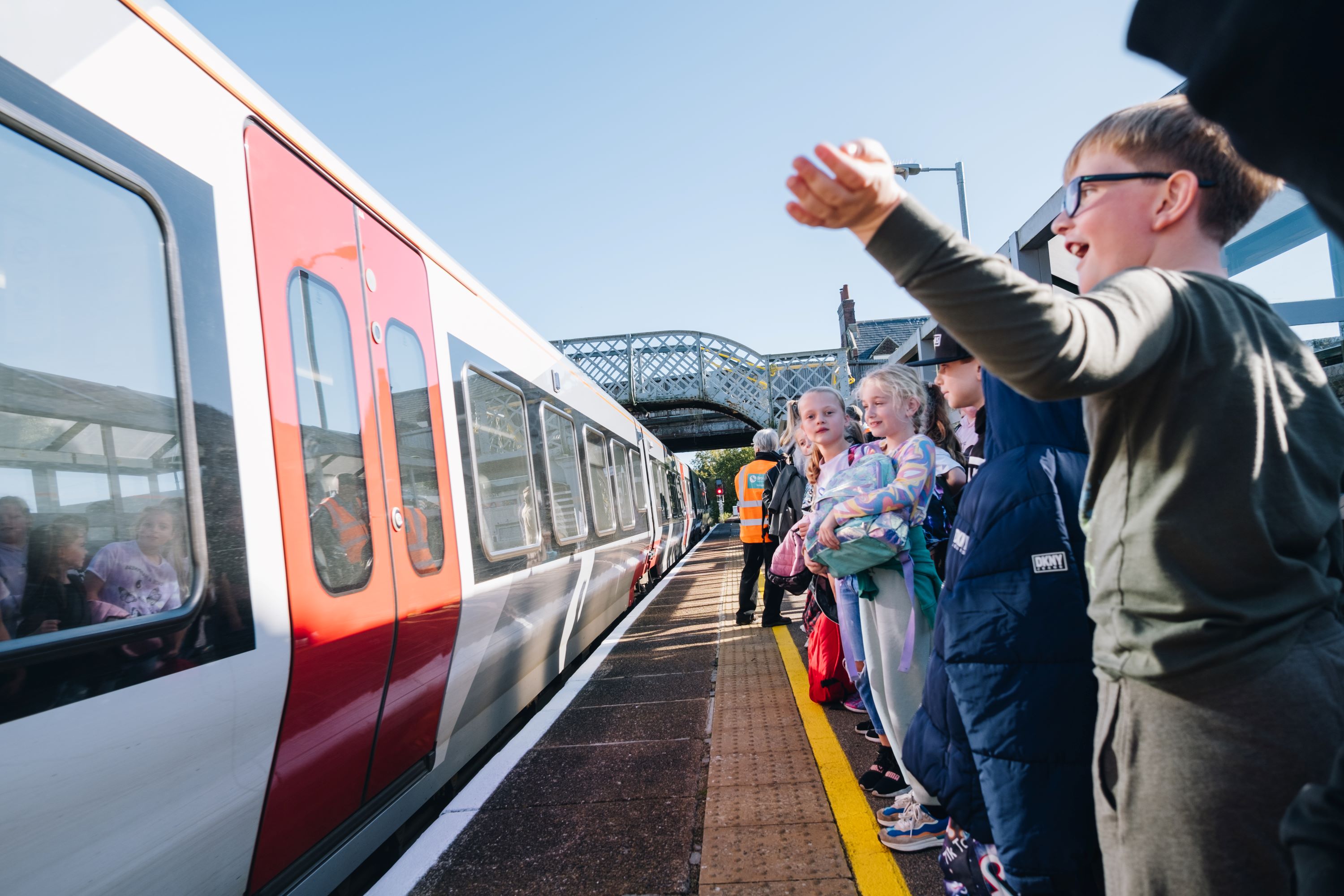
Students from Norfolk and Suffolk primary and secondary schools and colleges enjoyed trips by train to explore nature reserves, open marshes and riverside paths, with the opportunity to see some of the area’s rare wildlife – soaring marsh harriers, otters playing in the water, kingfishers diving from riverside branches, dragonflies, damselflies and even the incredibly rare swallowtail butterfly. The project was part of the National Park Capability Fund, supported by Active Travel England.
Now it’s your chance to make the journey part of your holiday or day out with travel by rail. So many Broads destinations can be reached by rail, from the city and the coast to small villages like Worstead (home of worsted cloth, woven in the village during the Middle Ages) and Somerleyton (with Somerleyton Gardens to visit). We also have one of the most remote stations in England – the tiny Berney Arms, a ‘request’ stop. You can see how the landscape changes as you travel and if time is short, you can see a lot of the Broads even on a day trip. Seven of our local stations were recognised in Greater Anglia’s 2025 Station Adopter Awards, thanks to the work of community volunteers.
The bitternline.com, wherrylines.com and eastsuffolklines.co.uk sites have lots of walks and ideas for places to visit from stations (some may require a walk to reach them), with links to greateranglia.co.uk for timetables and tickets. Please check timetables very carefully, as service times vary throughout the day, may be infrequent and may change. Fares may also change. You’ll find walks from many Bittern and Wherry Lines stations under Railway Rambles in Short and circular walks on norfolk.gov.uk/trails
The Bittern Line goes north from Norwich to Sheringham on the North Norfolk coast, passing through the northern Broads, while the Wherry Lines go east and south, one branch to Great Yarmouth and the other to Lowestoft, from where the East Suffolk Lines continue to Beccles and then further into Suffolk. The line websites include maps. For more public transport details, go to VisitTheBroads.co.uk/getting-here. Why Bittern and Wherry? The bittern is one of the rarest Broads birds – it moves silently through reeds looking for fish and in spring the males making a booming noise. Wherries were the traditional cargo boats used on the Broads and many travelled to and fro between Norwich and Great Yarmouth.
Three places to explore from stations
Norwich
on the Bittern Line and the Wherry Lines
The present station building itself (dating from 1886) is full of historic interest and is right opposite the River Wensum, which is part of the Broads where it flows through the city. If you’re exploring by boat rather than train, our Norwich Yacht Station is close to the railway station. The river was at the heart of the very development of the city – vital for defence and trade. The Riverside Walk will help you explore – look out for the Boom Towers, Cow Tower a swan pit and historic bridges. The grounds of Norwich’s Anglican cathedral adjoin the river and it’s a short walk to the historic market, museums and more medieval churches than any other city in Western Europe north of the Alps.
Berney Arms for Halvergate Marshes
on the Wherry Lines
This is a great station for walkers – it’s on the Wherryman’s Way and Weavers’ Way (for details go to norfolk.gov.uk/trails), as well as the River Yare. Use the adjacent stations on the line at Great Yarmouth or Reedham to journey by train one way and walk the other way, explore the Halvergate Mills Trail (Berney Arms Mill is close to the station) or just enjoy the expanses of the marshes and their wildlife, including the RSPB’s Berney Marshes and Breydon Water nature reserve. If you want to get away from it all, this is a place for you, but please plan your visit carefully, there is no road access. For boaters, there are moorings at Berney Mill.
Oulton Broad
Oulton Broad North is on the Wherry Lines and Oulton Broad South is on the East Suffolk Lines
There are boat trips and day boats for hire, or you can explore Lowestoft Museum in Broad House, within Nicholas Everitt Park on Bridge Road. It’s probably best known for its important collection of 18th-century Lowestoft porcelain. More recently, the park hit the headlines when it was one of several locations to attract Banksy artworks during his ‘Summer Spraycation’ in 2021. “We’re all in the same boat” can still be seen on a bridge in the park. You can also see Mutford Lock, close to the park. It was constructed in 1828 as part of a scheme to provide Lowestoft with a direct route to Norwich, avoiding the high tolls charged by Great Yarmouth at the time. The scheme included opening Lake Lothing to the North Sea to provide a harbour. The lock connected Lake Lothing with Oulton Broad, providing controlled navigational access on to the broad and now provides access for private boats between the North Sea at Lowestoft and the Broads. From either station you can take a walk to Suffolk Wildlife Trust’s nature reserve at Carlton Marshes (about 20 minutes from the South station and about 40 minutes from the North station). It has good accessible routes and a visitor centre with cafe.
thesuffolkcoast.co.uk/suffolk-coast-towns-and-villages/oulton-broad