


Wildlife is relocating
Grazing marshes and fens are being restored and managed to provide habitat for what may sound a bit like the ingredients for a witch’s cauldron…
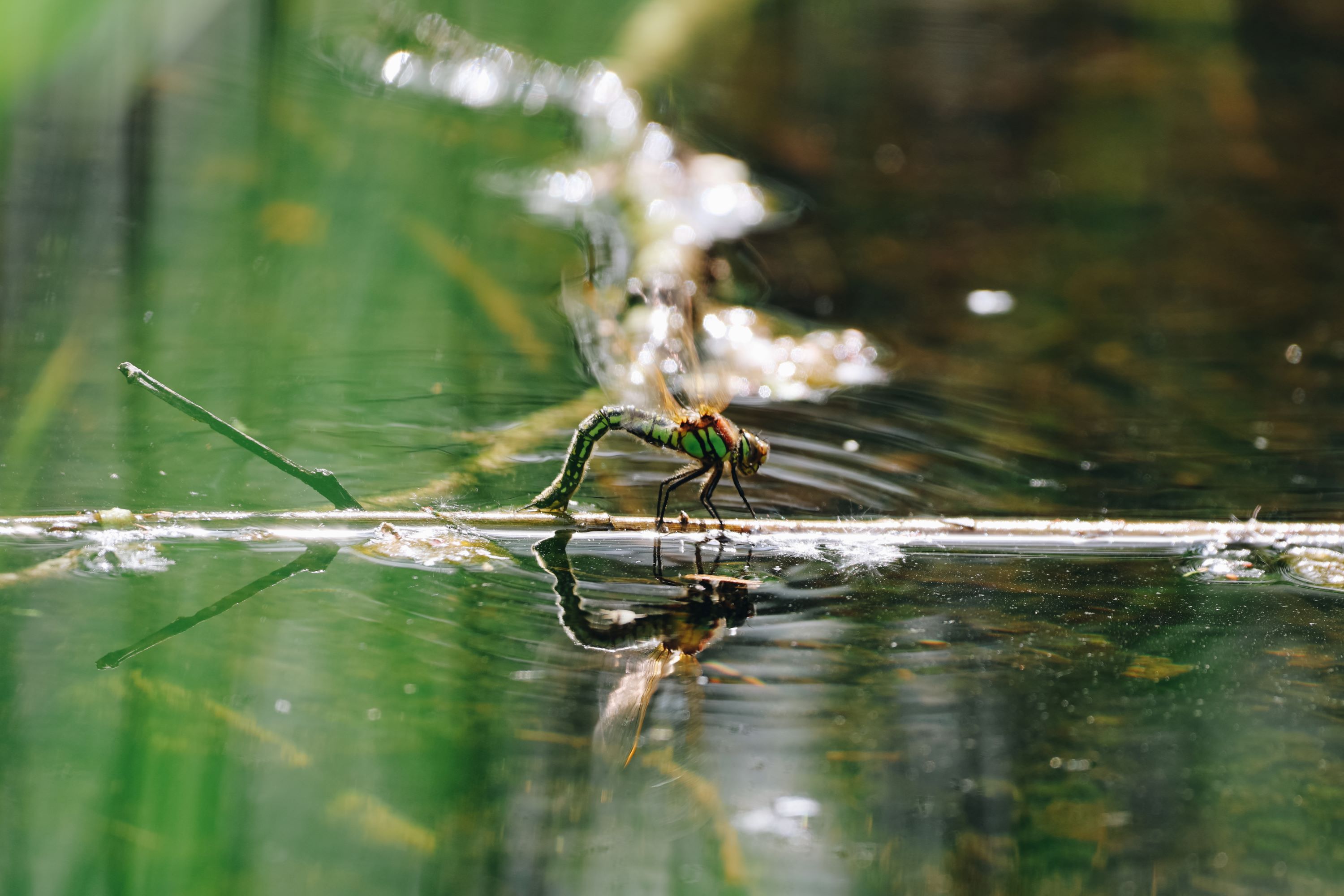
A quarter of the UK’s rarest wildlife species live in the Broads. Some of the key wildlife we’re helping includes the fen raft spider, Norfolk hawker dragonfly and swallowtail butterfly, as well as toads, bats, grasshoppers, snails, snakes and fen plants. Research, habitat restoration and wildlife translocations are boosting resilience in many species, and preparing the Broads for a changing climate.
A general diversity of flowers benefits insects and other pollinators. Clean, well-managed ditches provide habitat for aquatic wildlife including dragonfly larvae, space for nursery webs for spiders and bat foraging paths. Waterbody edge structures provide areas for bats to feed, dragonfly perches and butterfly basking areas. Ponds provide habitat for amphibians as well as fish, which then provide food for bitterns and similar birds.
Collaborative projects, many long-term, are being carried out across the Broads by the Broads Biodiversity Partnership. The Broads Local Nature Recovery Strategy (LNRS) was published in autumn 2024, and the Norfolk and Suffolk LNRSs in autumn 2025, all providing guidance for nature recovery into the future.
Broads Nature Recovery Strategy 2024-29
Local Nature Recovery Strategy - Norfolk's Local Nature Recovery Strategy - Norfolk County Council
Local Nature Recovery Strategy (LNRS) - Suffolk County Council
What wildlife is benefiting and how?
Fen raft spider
The Broads National Park has seen remarkable success in rescuing the fen raft spider from possible extinction. Starting in 2010, conservation partners reared spiderlings in captivity – often in test tubes – before translocating them (moving or reintroducing a species into the wild) to restored grazing marsh habitats across Castle Marshes, Carlton Marshes, Mid‑Yare Marshes and Ludham Marshes. These sites, characterised by lovely clear-water ditches and rich vegetation, allowed spiderlings to thrive. By 2020, established populations increased from three to seven.
Today, work continues thanks to a partnership that includes experts from Natural England, the Suffolk and Sussex Wildlife Trusts, the Broads Authority, the British Arachnological Society and the RSPB. The programme also includes research into the molecular ecology and evolution of this species, carried out initially at the University of East Anglia and, more recently, at the University of Nottingham’s SpiderLab. This work will improve understanding of genetic diversity, guide conservation and future translocations, and help assess broader ecosystem health.
What are we doing?
Creating and restoring grazing marshes and their ditches to benefit fen raft spiders and other wildlife. We’re supporting translocations to mitigate low genetic diversity and enhance long-term resilience to threats such as salt incursions and drought. Formal consent from Natural England and often other organisations is required for translocation.
Norfolk hawker dragonfly
Once restricted to the Broads, the Norfolk hawker has expanded further across the UK in recent years. In 2025 this included sites in Cambridgeshire, Kent, Oxfordshire, Herefordshire, Glamorgan (Wales), Dorset, Devon and even as far as Northumberland, close to the Scottish Borders. Its improved range is attributed to enhanced water quality, habitat restoration (such as at Whitlingham Broad) and warmer temperatures linked to climate change.
What are we doing?
Monitoring dragonfly colonisation in restored sites – this helps track early indications of wider ecosystem recovery. Restoration work we’re doing for the fen raft spider also benefits dragonflies.
Swallowtail butterfly
The Broads remains the only British site where this subspecies thrives, laying its eggs almost exclusively on milk parsley, food plant for its caterpillars. The butterfly depends on well-managed fen habitats, such as at How Hill, Hickling and Strumpshaw.
What are we doing?
We are assessing the 16 swallowtail breeding sites in the Broads and supporting a funding bid for species recovery. Volunteers are growing and planting milk parsley in restored fens. A Milk Parsley Seed Collection Project, funded by the Broads Authority and the Otter Trust, is propagating seeds collected across Norfolk at Earsham Wetland Centre. The aim is to produce 10,000 plants over the next three years, with additional plants made available for other conservation projects. Non-native deer (particularly Chinese water deer) feed on milk parsley, which could be having an impact on swallowtail butterfly populations – the Norfolk Deer Strategy is addressing this.
Natterjack toad
Natterjack toads are not commonly found in the Broads these days, but are an important species of the UK’s coastal dunes and heathlands. They need open terrain with sandy soils for burrowing, shallow pools for breeding and sparse vegetation for movement.
What are we doing?
Plans are in place to translocate natterjacks as part of a reintroduction project at Winterton Dunes. The project will start when water levels are high enough in the dune pools.
Nathusius’ pipistrelle bat
In the UK, this rare migratory bat appears to be expanding, but there’s a lot more we need to know about it. The National Nathusius' Pipistrelle Project (2011-2022) collected thousands of records, revealing breeding colonies in the Broads, Kent, Surrey, the London area and Northumberland. There were even occasional records of bat migration over the North Sea to the Netherlands and beyond, for example to Latvia and Spain. This bat loves waterbodies, so the Broads is an ideal and important site.
What are we doing?
Wetland habitats within the Broads that are close to riverbanks and waterbodies are ideal foraging and roosting areas – so we’re surveying these. The Norfolk and Norwich Bat Group is monitoring for these bats at bat boxes around waterbodies such as Whitlingham Broads and the Trinity Broads. Studies using radio telemetry have traced bat movements between the UK and mainland Europe.
Large marsh grasshopper
The return of the UK’s largest grasshopper to wetlands across Norfolk has been a major success story.
What are we doing?
Since 2019, about 6,500 captive-reared large marsh grasshoppers have been released into six sites in Norfolk, including Chedgrave Common in the Broads. We’re continuing reintroductions at additional locations in Norfolk to restore this species to its former range.
Little whirlpool ramshorn snail
This tiny (5mm) snail acts as a living indicator for ditch health. If it’s present, the ditch is in good condition; if it’s absent, something’s gone wrong. Once found at around 15 sites across south-east England, its range has now shrunk dramatically. Today, it’s largely confined to just three areas: the Broads, and the Arun Valley and the Pevensey Levels in Sussex. Thanks to the Back from the Brink project (2017-2021), we now have a much clearer understanding of how to manage ditches to support this rare species. The project showed that clearing ditches in rotation (rather than large areas all at once), as we do in the Broads, effectively maintains populations of this and other rare minibeasts. The Waveney Valley and other parts of the Broads remain strongholds, with beautiful clear-water ditches, rich in aquatic plants.
What are we doing?
Collaborating with the Department for Environment, Food and Rural Affairs to ensure that farmers are supported to continue traditional, low-intensity grazing that maintains healthy ditch systems. We’re also improving water quality and addressing flow issues to sustain snail populations and wider freshwater biodiversity.
Adder
Adders are an important indicator of healthy landscapes but have declined across the UK. Norfolk and Suffolk have some lovely habitat for adders, but surprisingly few records of them, so adder recovery is a high priority.
What are we doing?
A new Adder Population Genetics Project is underway across Norfolk and Suffolk, including sampling from Hickling Broad, Winterton Dunes and Broadland Country Park, with additional samples planned from Haddiscoe Island and Calthorpe Broad. This will help assess genetic diversity and connectivity of populations across the Broads. Adder workshops have been held in Norwich to review adder distribution maps produced by species experts and data modellers, and to identify opportunities to enhance habitat corridors connecting fragmented populations. We’re exploring funding for habitat creation.
Fen plants
The Broads has around 1,700 hectares of wildlife-rich open fen – the largest expanse in lowland Britain. The Broads fens are home to species such as the rare fen orchid, marsh orchid and crested buckler fern.
What are we doing?
By 2010 the fen orchid was only found at four UK sites (three in East Anglia). Since then, thanks to the English Fen Orchid Conservation Strategy (with partners including the Broads Authority) there are now 10 UK sites and it’s no longer classed as endangered. We’re modelling future climate conditions to identify areas most likely to remain suitable for fen species. We’re translocating small turfs of fen vegetation, such as from Sutton Fen to Leighton Moss in Lancashire, to safeguard species under changing conditions. We’re also assessing the upper reaches of the Broads for future restoration and translocation potential.
What can we all do?
- Care for nature: Do not disturb wildlife, damage plants, or interfere with farm machinery.
- Control your dog: Keep dogs under close control, especially around farm animals and during nesting seasons. Bag and bin dog waste in public bins or take it home.
- Take your litter home: Leave no trace of your visit and do not light fires unless signs permit it.
- Help keep wildlife healthy by allowing ducks, geese and other animals to rely on their natural diet.
- Citizen scientists (that can be anyone!) can contribute valuable data via various platforms – if you see a Norfolk hawker you can join in the monitoring by reporting it on the iNaturalist app.
- Many Broads Biodiversity Partnership member organisations (including the Broads Authority) welcome volunteers and depend on them to carry out projects. So do get in touch if you’d like to help, or if you’d like more information about what else you can do to help wildlife, now and for the future. For details about volunteering with the Broads Authority go to Volunteering.
Broads Biodiversity Partnership
Go to Conservation translocations to see the list of member organisations.